Quick answer: AI agents in financial planning are structured, goal-driven systems that decompose planning tasks like budgeting and variance analysis into subtasks, execute them across connected accounting systems, and present outputs for human review. The finance controller stays in charge. The grunt work gets delegated.
You have 14 tabs open. Three of them are the same spreadsheet saved under different names. One has a broken VLOOKUP you fixed last Tuesday but somehow broke again. Month-end close is in two days, and you still need to reconcile intercompany transactions, rebuild the variance commentary, and pull together the financial section of the board pack.
Sound familiar?
Now here is the part that might surprise you: 58% of FP&A professionals report not using AI at all (FP&A Trends, 2025). Not because the technology does not exist. Because most finance professionals are not sure what AI agents actually do in financial planning, whether they can be trusted, and how they differ from the chatbot their CEO keeps referencing in town halls.
This post breaks that down.
Why Is There a Perception Gap in AI Finance Adoption?
A 24-point gap exists between how executives and staff-level finance professionals perceive AI adoption in their own organizations. Seventy-four percent of executives say their organization uses AI in finance, compared to only 50% of staff-level respondents (Vic.ai, 2025).
That gap matters. It means leadership is making strategic bets on AI-driven finance while the people who actually build the budgets, run the close, and prepare the board pack are not seeing those tools in their day-to-day workflow. Only 12% of finance teams are actively using AI tools today, while 63% remain stuck in evaluation or planning stages (Accounting Seed, 2025).
This is not a technology problem. It is a clarity problem. Finance controllers do not need another pitch about “transforming insights.” They need to know, specifically, what an AI agent does when it sits inside their planning workflow.
How Do AI Agents Differ From Copilots in Financial Planning?
Most finance professionals encounter AI as a copilot: you type a prompt, you get a response. ChatGPT drafts a variance commentary. Claude summarizes a financial report. Perplexity pulls benchmark data. These tools are useful, but they are reactive. They wait for you to ask, and they answer one question at a time.
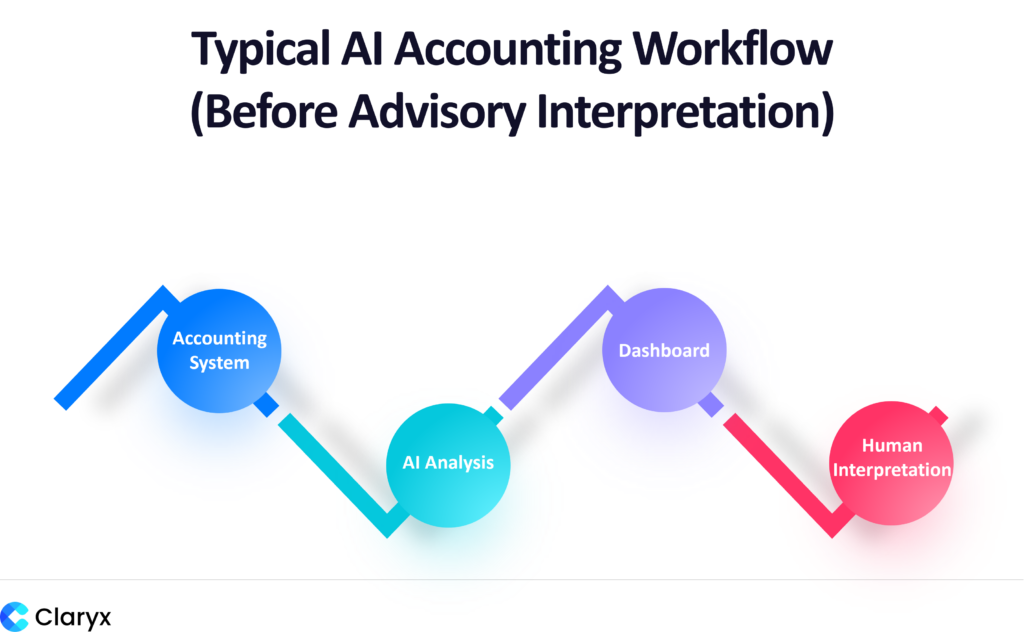
AI agents in financial planning work differently. An agent does not wait for a prompt. It receives a goal, decomposes that goal into subtasks, executes those subtasks across connected systems, and delivers a structured output for review (Board International, 2025).
Here is what that looks like in practice:
- Copilot approach: You ask ChatGPT to “write a variance commentary for Q4 OPEX.” It generates plausible-sounding text. You then manually check every number against your actuals.
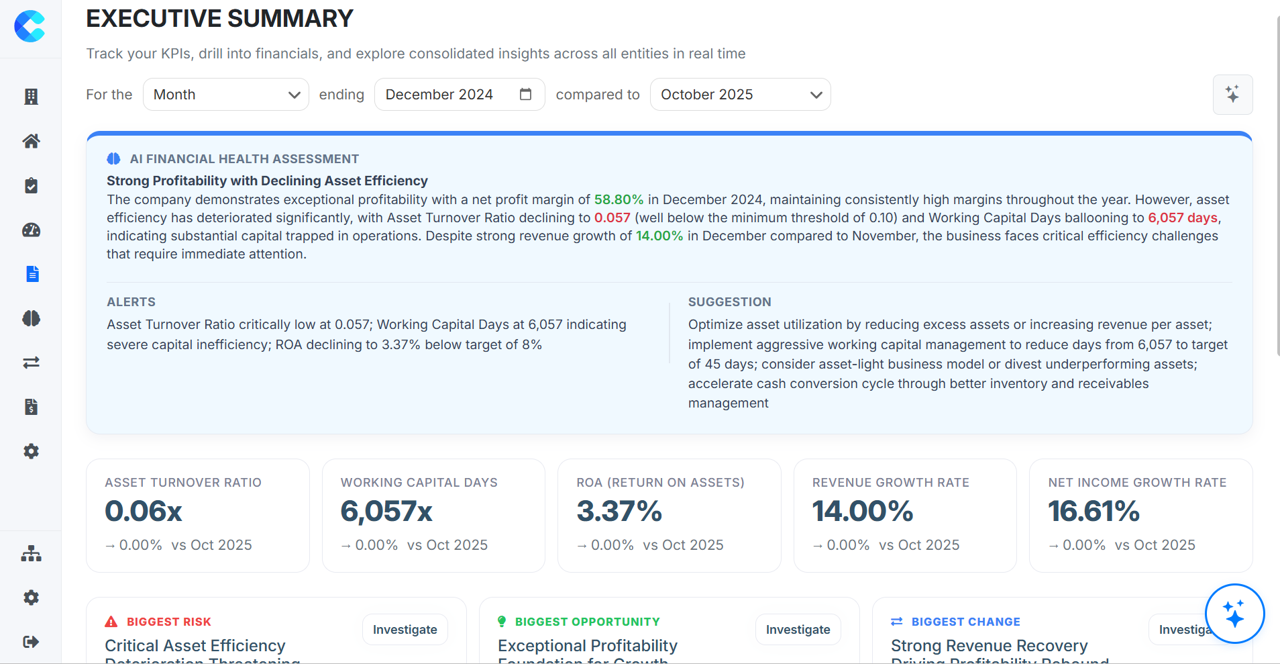
- Agent approach: You connect your accounting system. The agent pulls your actual vs. budget data, identifies the material variances, traces them to specific GL lines, drafts commentary with the numbers embedded, and presents the full analysis for your review. If something looks off, you override it.
The difference is not intelligence. It is workflow integration. Agents operate across systems. Copilots operate inside a chat window.
What Does “Agentic” Mean in Financial Planning?
“Agentic AI” sounds like marketing language, but the underlying concept is straightforward. An agentic financial planning system has four properties:
- Goal decomposition. You give it an objective (“build a 12-month budget”), and it breaks that into subtasks (pull historical data, apply growth assumptions, link revenue to headcount, generate P&L/balance sheet/cash flow).
- Tool use. It connects to your accounting platform, your CRM, your HR system, and executes actions across them.
- Iterative reasoning. It checks its own outputs, flags anomalies, and adjusts before presenting results.
- Human-in-the-loop. It stops at defined checkpoints for your review and approval.
This is conditional automation, not autonomy. The agent acts within boundaries you define: specific tools, crafted prompts, and explicit stopping rules (FP&A Trends, 2025).
What Do AI Agents Actually Do in the Financial Planning Workflow?
Finance teams that have adopted agentic AI are using it across three core areas. None of them involve replacing the finance controller.
AI Budgeting: Automated Budget Construction
Building a budget from scratch is one of the most time-intensive tasks in finance. It requires pulling historical actuals, applying assumptions across departments, linking revenue drivers to cost structures, and ensuring the P&L, balance sheet, and cash flow all tie together.
An AI agent automates the construction phase of AI budgeting. It pulls your historical data from Xero or QuickBooks, applies assumption frameworks you define, builds the interlinked model, and presents a complete draft budget with every assumption documented at the cell level. You review the logic, override where your business context dictates, and approve.
The agent builds. You judge.
Variance Analysis and Reporting
Variance analysis is where finance controllers spend a disproportionate share of their time, not because the analysis itself is complex, but because the data gathering and formatting is tedious. Pulling actuals, comparing to budget, identifying material movements, drafting commentary, formatting for the board.
AI agents in financial planning collapse this into a single workflow. Connect your data source, define materiality thresholds, and the agent generates a complete variance report with narrative commentary. Adam Hancock, VP of FP&A at EBSCO Industries, describes the shift as cutting “hours of manual effort into a few clicks” for board-ready summaries (FP&A Trends, 2025).
Rolling Forecasts With Agentic Financial Planning
Static annual budgets are increasingly insufficient for growing SMEs. But maintaining a rolling forecast in spreadsheets is painful. Every month you re-forecast, you are rebuilding formulas, updating assumptions, and hoping nothing breaks downstream.
Agentic financial planning treats forecasting as a continuous process. Agents ingest new actuals as they land, re-run the forecast model against updated assumptions, and flag where projections have shifted materially from the prior period. The controller reviews the changes, not the entire model.
Why Is Trust the Biggest Barrier to AI Agents in Finance?
Seventy percent of FP&A professionals trust AI only for low-risk tasks, and just 3% express near-complete trust in AI outputs (FP&A Trends, 2025). The technology works. The bottleneck is trust.
This is rational. Finance controllers sign off on numbers that go to boards, investors, and regulators. A hallucinated revenue figure is not a minor inconvenience. It is a professional liability.
That is why the “agents propose, humans approve” model matters. The most effective agentic financial planning systems are not black boxes. They show their reasoning. Every number traces back to a source. Every assumption is documented. Every calculation is auditable.
Trust does not come from AI being right 100% of the time. It comes from being able to verify the output in less time than it would take to build it yourself.
Why Spreadsheet Patchwork Blocks AI Agent Adoption
Sixty-nine percent of organizations have attempted to build automation internally, layering OCR systems, workflow apps, and RPA scripts on top of spreadsheets (Vic.ai, 2025). Here is something most AI vendors will not tell you: the biggest obstacle to AI agents in financial planning is not the AI. It is the patchwork of systems it needs to connect to.
The result is a fragile stack where every new tool adds complexity without eliminating the underlying manual work.
Agents need clean data pipelines to function. That means direct connections to your source of truth, whether that is Xero, QuickBooks, or a mid-market ERP. Without that connection, you are just adding another layer to the patchwork.
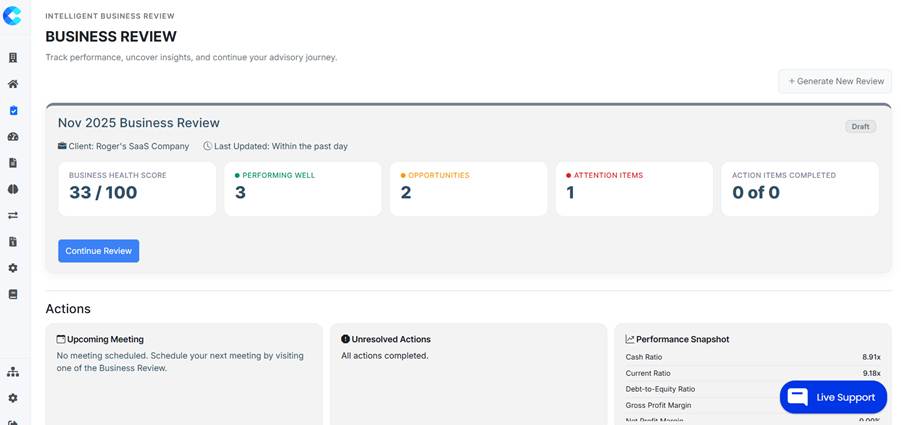
This is where platform choice matters. Planir connects directly to accounting platforms like Xero and QuickBooks, deploys AI agents that build budgets, generate reports, and produce variance analysis from your live financial data, and presents every output for the finance controller to review, override, and approve. It is designed for the growing SME where the FC needs analyst-equivalent output without analyst-equivalent headcount.
What Results Are Early Adopters of AI Agents Seeing?
Early adopters have reduced close times by up to 50% (Board International, 2025), making the productivity case for agentic AI in finance harder to ignore:
- Accenture projects AI-enabled decision agents could reduce manual finance workload by up to 40% (Accenture, 2025).
- CFOs project a 24% improvement in forecast accuracy by 2027 (Gartner, 2025).
These are not theoretical projections from lab environments. They reflect outcomes from finance teams that have moved past the evaluation phase and into production use.
For Singapore-based SMEs specifically, the incentives are aligning. AI adoption among SMEs tripled from 4.2% to 14.5% between 2023 and 2024, and the 2026 Singapore Budget includes a 400% tax deduction for qualifying AI expenditure alongside SG$150 million for the Enterprise Compute Initiative (Singapore Ministry of Finance, 2026).
Why Building Your Own AI Agent Is Harder Than It Looks
You can prototype an AI agent in an afternoon, but getting it to production takes months. Production agents face malformed inputs, API timeouts, and context that shifts mid-execution (FP&A Trends, 2025).
This is why most finance teams should not build their own agentic financial planning systems. The prototype looks impressive in a demo. The production version requires engineering for every edge case your accounting data can throw at it: partial syncs, chart-of-accounts changes, multi-entity consolidations, currency conversions.
Buying a purpose-built platform is not a shortcut. It is the recognition that your competitive advantage is financial judgment, not AI infrastructure.
What Should Finance Controllers Do About AI Agents?
AI agents in financial planning are not what most people think. They are not autonomous decision-makers. They are not chatbots with accounting knowledge. They are not a replacement for the finance controller.
They are structured systems that do the construction, formatting, and analytical grunt work so the controller can focus on judgment, narrative, and strategy.
The 58% of FP&A professionals who have not adopted AI yet are not behind. But they are standing at a narrowing window. As agentic financial planning tools mature and connect more deeply to accounting platforms, the gap between teams that build everything manually and teams that review agent-generated outputs will widen.
The question is not whether AI agents will become part of financial planning. It is whether you will be the one managing them, or the one still managing spreadsheets.
If you are ready to see what AI agents look like inside an actual planning workflow, explore how Planir automates investor updates or compare the best financial reporting tools for SMEs.
References
Accounting Seed. (2025). 2025 AI in accounting survey. https://www.accountingseed.com/blog/ai-accounting-survey-2025
Accenture. (2025). AI-enabled decision agents in finance: Workforce impact projections. https://www.accenture.com/us-en/insights/artificial-intelligence
Board International. (2025). From automation to autonomy: Agentic AI in financial planning. https://www.board.com/en/blog/agentic-ai-finance
FP&A Trends. (2025). FP&A Trends Survey 2025: AI adoption in financial planning and analysis. https://fpatrends.com/survey-2025
Gartner. (2025). Agentic AI in finance: 2025 market analysis and 2030 forecast. https://www.gartner.com/en/finance/insights/agentic-ai
Singapore Ministry of Finance. (2026). Budget 2026: Enterprise AI initiatives. https://www.mof.gov.sg/budget2026
Vic.ai. (2025). The AI perception gap in finance: Executive vs. staff adoption survey. https://www.vic.ai/resources/ai-perception-gap-finance