Category: ai for accounting

  • From Spreadsheet Chaos to Clarity: How Planir Transforms Financial Business Reviews

    From Spreadsheet Chaos to Clarity: How Planir Transforms Financial Business Reviews

    AI accounting software for financial business reviews is often discussed in terms of automation and efficiency. In practice, most finance teams still spend hours rebuilding spreadsheet-based reports that explain what happened, but not why it matters.

    We all know the drill and relate to the challenges: On a Sunday evening, a finance manager may need to rebuild last month’s board report for the third time. The numbers are right—she’s checked them twice—but the variance commentary still doesn’t explain why gross margin dropped 4.2 percentage points. Her CEO will ask. He always does. And the answer is buried somewhere across eighteen Excel tabs, each feeding the next in a fragile chain of formulas one misplaced decimal could break.

    This scene repeats itself thousands of times each month, in businesses of every size, in every sector. The monthly financial review, meant to inform strategy and guide decisions, has become a grinding exercise in data wrangling. Hours vanish into reconciliation, formatting, and narrative assembly. And by the time the report is ready, its most urgent insights are already stale.

    The root cause is not lack of data. It is the opposite: too much data, living in too many places, with too few systems designed to translate financial movements into decision-ready clarity.

    At Planir, we are building our solution around solving this problem. Not by adding more dashboards, but by rethinking the structure of the financial review itself.

    The unseen cost of manual reviews in traditional business accounting software and legacy bookkeeping cloud software

    In accounting and finance, the term “month-end close” understates the real work involved. Closing the books is one thing. Making sense of what they reveal is another entirely.

    Research from MIT and Stanford found that accountants using traditional methods take an average of 7.5 additional days per month to finalize management reports and client reviews compared to those using AI-supported tools. For a mid-sized accounting firm managing 40 clients, that inefficiency compounds to nearly 25 working weeks per year—time that could be redirected toward advisory work, where clients see greater value and firms command higher fees.

    The problems are structural:

    ChallengeImpact
    Inconsistent formatsEvery review rebuilt from scratch
    No variance intelligenceCommentary written manually
    Lack of narrative flowInsights buried in tables
    Version control chaosErrors introduced in iteration

    These are not edge cases. They are the daily reality for finance teams without integrated review infrastructure.

    What a business review needs to do

    The purpose of a financial review is not to present numbers. It is to explain performance, highlight risks, and prompt decisions. Yet most tools are built for the former, not the latter.

    A useful business review must:

    • Aggregate data automatically from source systems without manual exports.
    • Identify material movements and flag what changed, where, and by how much.
    • Explain variance drivers in natural language, not accounting shorthand.
    • Structure insights thematically about cash, profitability, growth, risk etc. so discussions stay focused.
    • Enable collaboration by capturing decisions, assigning actions, and tracking follow-up

    Until recently, achieving this required stitching together multiple tools: accounting platforms for data, BI dashboards for visuals, spreadsheets for narrative, and email threads for follow-up. The result was friction at every seam.

    Planir was designed to collapse that stack into a single, purpose-built workflow.

    How Planir builds a business review

    Planir’s Business Review feature operates on a simple premise: financial data should flow directly into structured, narrative-driven summaries without human reformatting.
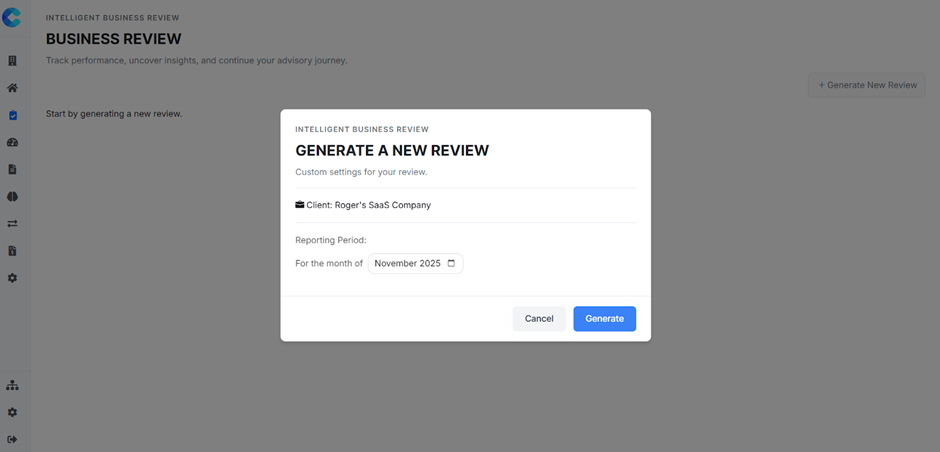
    ai accounting software Claryx.ai’s Platform: Generate a Business Review in seconds.


    Planir’s Platform: Generate a Business Review in seconds.

    Here’s how it works in practice.

    Step 1: Connect and sync your cloud accounting software in minutes.

    Planir integrates directly with Xero and QuickBooks Online via read-only, encrypted API connections. Once connected, the platform continuously syncs transactions, accounts, and entities, maintaining a live, always-current dataset.

    For firms managing multiple clients or businesses with several subsidiaries, this eliminates the first and most tedious bottleneck: getting the data into a usable state.

    Step 2: Accounting automation to automatically detect variances and anomalies

    Each time a review is generated, Planir compares the current period against prior months, budgets, or forecasts. It flags movements in revenue, cost of goods sold, operating expenses, margins, cash flow, and other core metrics.

    Most importantly, the system doesn’t just highlight what changed. It identifies why it changed: drilling from high-level totals down to account-level drivers.

    If operating expenses increased 12%, the platform traces that back to specific categories: payroll, software subscriptions, professional fees. If gross margin compressed, it surfaces whether the cause was pricing pressure, rising input costs, or shifts in product mix.

    This root-cause analysis, which traditionally required manual investigation, happens automatically.

    Step 3: Transforming complex data into plain-English narratives with accounting reporting automation

    Once variances are detected, Planir translates them into natural language summaries. Instead of presenting a table with rows of percentage changes, it produces sentences like:

    “Revenue grew 8% to $124,000, driven primarily by a 15% increase in subscription income, partially offset by a 22% decline in one-off project fees.”

    Or:

    “Operating cash flow tightened to $18,000 as accounts receivable grew faster than collections, extending average debtor days from 32 to 41.”

    These narratives are not static. They update dynamically as data refreshes, ensuring every review reflects the latest position without manual rewriting.

    Step 4: Structured review sections

    Planir organises insights into thematic modules like profitability, liquidity, efficiency, growth, etc. mirroring the logical flow of a well-run board meeting or client advisory session. Each section surfaces key metrics, explains movements, and links to supporting detail.

    For teams accustomed to building slide decks or Word documents from scratch each month, this structure provides a repeatable starting point that can be refined, not rebuilt.

    Step 5: Collaborative action tracking

    Financial reviews should end with decisions. Yet without a system to capture those decisions and track follow-up, most insights evaporate into meeting minutes that no one revisits.

    Planir embeds task assignment and discussion threads directly into the review interface.

    If the CFO flags a cash flow concern, the platform allows the team to log the decision, assign ownership, and set a deadline; all within the same workspace where the insight was surfaced. When next month’s review is generated, unresolved actions reappear, closing the loop.

    What this looks like for a fictitious SaaS SMB

    Consider a SaaS business with $ 2.4 million in annual recurring revenue, operating across three product lines and serving enterprise and SMB segments. Month-end historically may have consumed fourteen hours of finance team time: six hours on data consolidation, five on variance analysis, and three on narrative drafting.

    After implementing Planir, the same process may take less than three hours. The platform pulls data overnight. Variance explanations are pre-generated. The finance lead spends her time reviewing the narrative, adding context where needed, and preparing talking points for the executive team; not formatting cells or hunting for the source of $11,000 discrepancy.

    The time saved is one outcome. The consistency is another. Every review now follows the same structure, uses the same language, and surfaces the same categories of insight. New hires onboard faster. Board members know what to expect. And the finance function shifts from reporting on the past to guiding what comes next.

    Stop building reports. Start delivering insights.

    Planir is augmented financial intelligence for accounting firms and finance teams. It doesn’t replace your judgment—it multiplies your capacity.

    A Wolters Kluwer survey found that 80% of accountants expect advisory work to grow by nearly 40% in 2026. But advisory requires time. Time you don’t have while rebuilding last month’s report for the third time.

    See Your First AI-Powered Business Review in Under 5 Minutes

    No credit card. No setup fees. No data migration. Just connect your accounting platform and watch Planir build your first review automatically. Simply connect your Xero or QuickBooks account (60 seconds, read-only access). Start Your Free Trial Now.
  • Planir Launches AI-Powered Advisory Platform to Help Accountants Deliver Higher-Value Services

    Planir Launches AI-Powered Advisory Platform to Help Accountants Deliver Higher-Value Services

    Planir, an AI-powered advisory platform, has officially launched with a mission to help accounting firms and businesses move beyond routine compliance work toward strategic, high-value advisory services.

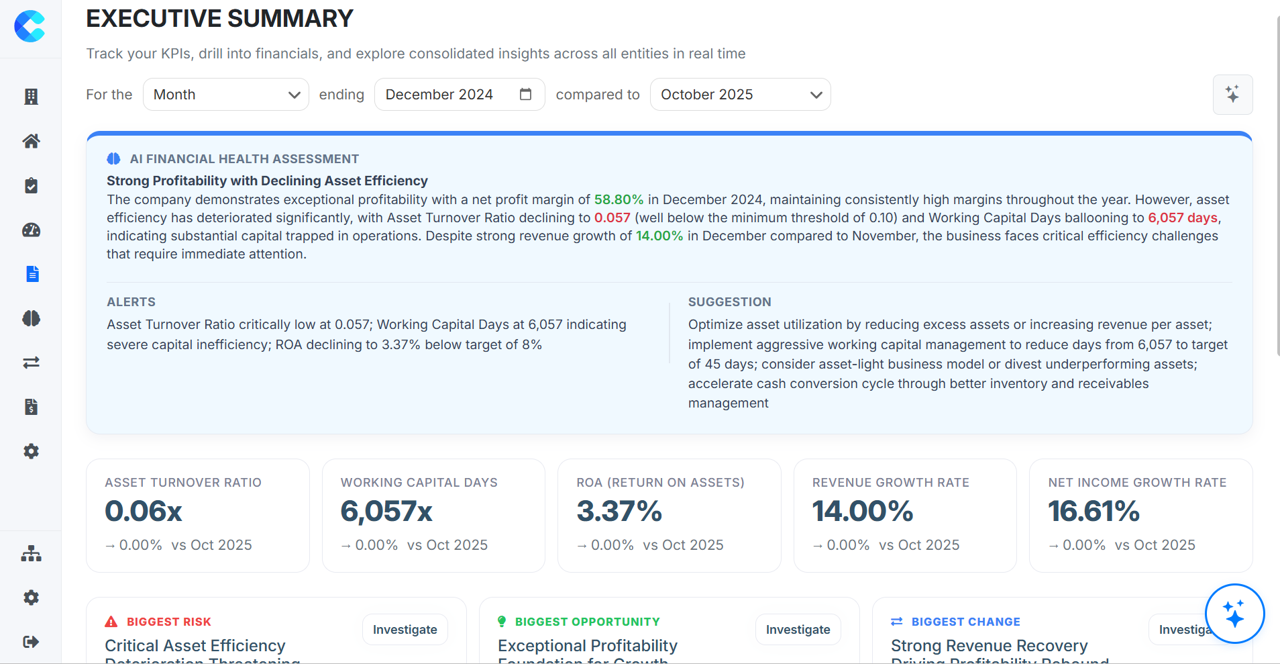
    Planir securely connects to existing cloud accounting systems including Xero and QuickBooks. Using AI, the platform analyzes financial data to surface trends, risks, and opportunities, delivering insights in clear, structured language that explains what has changed, why it matters, and what action to consider next.

    The platform serves two primary audiences: accounting firms seeking to expand their advisory capabilities, and small businesses looking for clearer visibility into their financial performance between accountant meetings.

    For accounting firms, Planir automates time-consuming data preparation, freeing accountants to focus on interpretation, client conversations, and advisory work that commands higher fees. For small businesses, it provides continuous financial intelligence and prepares owners to engage more productively with their accountants, replacing static month-end reports with ongoing, actionable insight.

    “The accounting profession is at a turning point,” said Jay Wang, Founder and Managing Director of Planir. “Compliance work is being commoditized, and clients increasingly expect strategic guidance, not just historical reports. We built Planir to help accountants reclaim their role as trusted business advisors, with AI handling the data analysis so they can focus on the judgment and context that only humans can provide.”

    Planir is designed to strengthen the relationship between accountants and their clients by creating a shared, continuous view of business performance. Rather than replacing accountants, the platform positions them at the center of strategic decision-making by helping teams spot issues earlier, understand performance drivers together, and shift from reactive reporting to proactive advisory.

    The platform features AI-powered business reviews, strategic alert systems, and conversational analysis capabilities that transform raw financial data into advisory-ready insights.

    Planir is now available to accounting firms and businesses, with pricing tiers based on organizational needs. A free tier is available for individual users, subject to plan limits.

    More information is available at website: Planir.

    About Planir

    Planir is an AI-powered advisory platform that helps accounting firms transform from compliance providers into strategic business advisors. By adding an intelligence layer on top of existing accounting systems, Planir enables firms to deliver clearer, more consistent advisory outcomes while helping businesses access financial guidance between accountant meetings. The platform is backed by ITLink Business Solutions, a Singapore-based technology consultancy with over three decades of experience in finance technology.

  • AI Accounting Software Explained: Why Automation Alone Doesn’t Create Advisory Value

    AI Accounting Software Explained: Why Automation Alone Doesn’t Create Advisory Value

    AI accounting software has become increasingly common as firms face rising client expectations, tighter timelines, and more complex financial environments. Yet despite rapid adoption, many accounting teams still struggle to translate AI-driven automation into meaningful insight or advisory value.

    Recent industry research shows that 56% of accountants spend a significant portion of their time on repetitive manual tasks, while only 26–50% of accounting activities are currently automated (Pardo, 2023). These figures highlight a paradox. AI accounting software is widely available, yet much of the profession remains constrained by operational work that limits interpretation, analysis, and decision-making.

    The issue is not the availability of AI accounting software. It is where its capabilities stop.

    How AI Accounting Software Is Commonly Understood (and Why That Definition Falls Short)

    The term AI accounting software is often used as a catch-all. In practice, it describes tools that solve very different jobs within accounting workflows.
    Most platforms focus on:

    • Capturing data faster
    • Processing transactions more efficiently
    • Producing reports with less effort

    These improvements matter, but they do not automatically produce insight or advisory clarity.

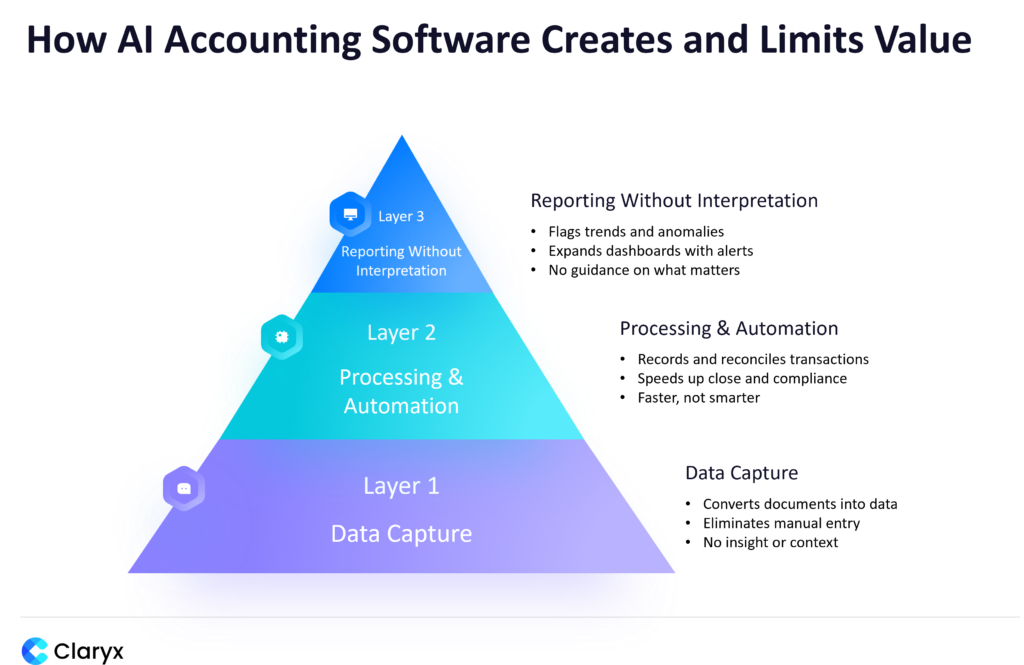
    To understand why Planir represents a structural shift, it helps to look at the three layers where AI is typically applied in accounting and where the real limitation emerges.

    Layer 1 of AI Accounting Software: Data Capture

    Data capture tools convert invoices, receipts, and bank statements into structured data. They address one of the biggest pain points in accounting: manual entry.

    This layer plays an important role in reducing workload and error, particularly given the high proportion of time still spent on repetitive tasks (Pardo, 2023). However, data capture only answers one question: what information do we have?

    It does not explain:

    • Why numbers changed
    • What patterns matter
    • What action should follow

    Data capture is foundational, but it is not where accounting value is created.

    Layer 2 of AI Accounting Software: Processing and Automation

    Processing tools take structured data and turn it into journals, ledgers, and reconciled accounts. This is where most cloud accounting systems operate today.

    Adoption here is accelerating. 43% of accountants have begun automating transaction processes, primarily to reduce repetitive work and improve efficiency (Brown, 2025). Platforms such as Xero, QuickBooks, and Zoho Books excel at this layer.

    But even at full automation, processing systems still focus on:

    • Recording what happened
    • Ensuring compliance
    • Closing the books faster

    They do not help accountants decide what the results mean. At best, they make firms faster not insightful.

    Layer 3 of AI Accounting Software: Reporting Without Interpretation

    Reporting tools were originally designed to visualise financial performance through dashboards and statements. More recently, many have added AI features to surface trends, flag anomalies, or generate basic narratives.

    This evolution reflects a broader shift. As automation reduces compliance effort, 95% of firms report having more capacity to redirect time toward client-facing and advisory work (Brown, 2025).

    Yet this is where most AI accounting software still falls short. Many platforms can show what changed, few can help accountants explain why it matters or what to do next.

    This gap between information and interpretation is where Planir changes the landscape.

    The Missing Advisory Layer in AI Accounting Software

    Planir is not designed to replace data capture, processing, or reporting tools. It is designed to sit on top of them.

    Where most AI accounting software stops at visualisation or detection, Planir focuses on structuring interpretation.

    Specifically, Planir helps accountants:

    • Prioritise which signals matter
    • Apply business context to AI-identified patterns
    • Translate financial movements into decision-ready insights
    • Prepare clearer, more focused advisory discussions

    Rather than treating insight as something accountants must manually assemble after reports are produced, Planir treats interpretation as a first-class layer in the workflow.

    This is why Planir is not just another reporting tool it represents a shift in how AI supports accounting work.

    From AI Accounting Automation to Advisory Enablement

    Many firms adopt AI accounting software to gain speed. The most competitive firms adopt it to gain clarity.

    Research consistently shows that accountants who treat AI as a collaborator remain actively involved in questioning outputs, applying context, and deciding how insights inform action extract more value than those who treat it as a replacement (Murray, 2025).

    Planir is built around this reality. It does not automate judgment, it supports it. By reducing the effort required to move from data to interpretation, Planir helps firms use AI not just to work faster,but to work at a higher level.

    If you want to test what happens when AI accounting automation is paired with structured interpretation, start a Planir trial.

    See how faster reporting becomes clearer advisory conversations without replacing professional judgment.

    Source

    ‌Murray, S. (2025, June 26). AI Is Reshaping Accounting Jobs by Doing the “Boring” Stuff. Stanford Graduate School of Business; Stanford University. https://www.gsb.stanford.edu/insights/ai-reshaping-accounting-jobs-doing-boring-stuff

    Pardo, S. B. (2023, May 12). Dext: 60% of accountants spend too much time on manual tasks. The Accountant. https://www.theaccountant-online.com/news/dext-60-of-accountants-spend-too-much-time-on-manual-tasks/

    QuickBooks. (2025, July 30). 2025 Intuit QuickBooks Accountant Technology Report | Intuit QuickBooks. Firmofthefuture.com. https://www.firmofthefuture.com/news/accountant-tech-survey-2025/

  • What AI Accounting Software Can and Cannot Do

    What AI Accounting Software Can and Cannot Do

    According to recent industry research, 56% of accountants report spending a significant portion of their time on repetitive manual tasks, while only 26–50% of accounting activities are currently automated (Pardo, 2023). This gap highlights an important reality: while AI tools are increasingly available, their impact depends less on adoption and more on how they are applied.

    That distinction becomes clearer when looking at specific accounting tasks. A consistent pattern emerges across firms: accountants who treat AI as a collaborator tend to extract more value than those who treat it as a replacement. The most effective professionals remain actively involved questioning outputs, applying business context, and deciding how insights should inform action (Murray, 2025).

    This highlights a structural limitation in today’s AI accounting and bookkeeping software landscape.

    What AI Accounting Software Does Well

    AI is highly effective at:

    • Extracting data from cloud accounting applications
    • Categorizing transactions at scale
    • Detecting anomalies across large datasets
    • Accelerating preparation work across bookkeeping and reporting cycles
    • Supporting accounting automation applications that reduce manual effort

    What AI Cannot Do on Its Own

    However, AI is not designed to:

    • Decide what is materially important
    • Translate signals into decisions
    • Structure insights for advisory conversations
    • Maintain accountability for recommendations

    Without an interpretive layer, firms risk using AI to move faster without necessarily moving smarter.

    Where the Gap Still Exists

    As AI adoption increases, many firms experience a familiar outcome:

    • Reports are produced faster
    • Alerts increase
    • Dashboards multiply

    Yet advisory conversations remain reactive, inconsistent, or deferred.

    This is not a failure of AI accounting software. It is a gap between analysis and application.

    AI identifies signals. Someone or something still needs to organize those signals into clarity.

    Where Planir Comes In

    This is the layer Planir is designed to support.

    Planir sits after AI analysis and before human judgment, helping accountants turn AI output into:

    • Prioritized insights
    • Plain-language explanations
    • Decision-ready narratives
    • Advisory-focused talking points

    Rather than replacing professional judgment, Planir strengthens it, reducing preparation effort while preserving accountability and context.

    In practical terms, Planir helps firms ensure that:

    • Automation supports understanding, not just efficiency
    • AI insights lead to proactive conversations
    • Advisory work scales without sacrificing quality

    Conclusion: From AI Tasks to Accounting Value

    AI for accounting is already highly capable at supporting operational tasks. What it does not do on its own is turn activity into understanding.

    That final step of prioritizing, explaining, and applying insight remains where accounting creates the most value.

    Planir exists to support that step. Not by replacing accountants but by connecting automation to judgment so AI-enabled firms don’t just move faster, they move with clarity.

    If you want to test what happens when AI accounting automation is paired with structured interpretation, start a Planir trial.

    See how faster reporting becomes clearer advisory conversations without replacing professional judgment.

    Sources

    Murray, S. (2025, June 26). AI Is Reshaping Accounting Jobs by Doing the “Boring” Stuff. Stanford Graduate School of Business; Stanford University. https://www.gsb.stanford.edu/insights/ai-reshaping-accounting-jobs-doing-boring-stuff

    Pardo, S. B. (2023, May 12). Dext: 60% of accountants spend too much time on manual tasks. The Accountant. https://www.theaccountant-online.com/news/dext-60-of-accountants-spend-too-much-time-on-manual-tasks/