Category: accounting advisory

  • Automation Didn’t Replace Accountants. It Changed What They’re Valued For.

    Automation Didn’t Replace Accountants. It Changed What They’re Valued For.

    Compliance Is Necessary, but No Longer Sufficient. Why many accountants feel busy, but constrained

    Most accountants did not enter the profession to simply produce reports. They did it because they wanted to bring order to complexity, help businesses make sense of their numbers, and support better decisions. Over time, however, much of that work has settled into a familiar rhythm: closing the books, reconciling accounts, preparing reports, and moving on to the next deadline.

    That rhythm exists for good reason. Compliance work is critical. It creates trust in financial information and forms the foundation of every credible advisory conversation. Clients depend on it, regulators require it, and firms take pride in doing it well. Yet for many finance professionals, there is a growing sense that this work, while essential, no longer reflects the full value they bring to their clients.

    As accounting has moved toward cloud accounting applications and more connected systems, expectations have shifted alongside it. Clients now have access to real-time data through bookkeeping cloud software and modern business accounting software, but access alone does not create understanding. What they increasingly look to their accountants for is interpretation, context, and guidance on what the numbers mean for future decisions.

    This shift is reflected across the industry. Research shows that accounting firms are moving away from a purely compliance-led model toward strategic advisory services, driven by client demand for empathetic, insight-led support rather than transactional outputs (Diaz, 2025). In this environment, compliance remains the baseline, but advisory becomes the differentiator.

    At the same time, the structure of the traditional business model for accounting firms naturally limits how value can be delivered and scaled. Compliance services tend to be concentrated around statutory and reporting cycles, which makes revenue seasonal and client engagement intermittent rather than continuous (Kelleher, 2025). This results in accounting firms staying stuck in a cycle of trying to improve their margins while remaining in a loop juggling rising workloads and client expectations (Kelleher, 2025).

    For accountants, this tension often shows up without them even realizing. The data is there. The understanding is there. Increasingly, firms are adopting AI for accounting and use of AI accounting software to reduce manual effort. Yet for some, insight still arrives late, conversations still happen after the fact, and opportunities to influence decisions pass without being surfaced in time. This begs the question of where the issue stems from?

    Well, compliance, by design, looks backward. Advisory looks forward. The challenge facing the profession is not whether compliance is still important, but whether it can continue to carry the weight of modern client expectations on its own. Increasingly, it is shown that it is not possible.

    Advisory Was Always the Destination

    Long before phrases like ai for accounting or accounting automation applications entered everyday conversation, advisory work was already part of the profession. It simply showed up inconsistently. Often it lived in conversations after meetings, in margin notes on reports, or in phone calls prompted by a client’s sudden concern. Advisory existed, but it depended heavily on individual experience and availability rather than structure.

    In practical terms, advisory is the work of helping a client understand what their numbers mean and what they should do next. It is not about producing more reports or adopting a consulting label. It shows up when clients ask why profit has changed despite steady revenue, where cash is being absorbed even though the business is growing, or which costs are starting to constrain performance. In those moments, the accountant moves beyond recording outcomes and into interpretation, trade-offs, and direction. That is advisory: translating financial information into implications for decisions, timing, and action.

    For many accountants, this is familiar territory. They understand their clients’ businesses deeply. They know which numbers matter, where risks tend to emerge, and how small operational changes can have outsized financial impact. What has historically been missing is not insight, but the ability to deliver it reliably and at scale.

    Research supports this view. As automation takes over repetitive and procedural tasks, the accountant’s role naturally shifts toward judgment, interpretation, and strategic thinking rather than execution (Murray, 2025). In this sense, advisory is not a new direction for the profession, but a re-emergence of its most valuable contribution.

    Productivity gains in finance do not primarily come from doing the same work faster, but from reallocating professional time toward higher-order activities such as explaining variance, evaluating trade-offs, and supporting decision-making (Church, 2025). This aligns closely with how advisory work has always functioned at its best: grounded in context, interpretation, and trust.

    The challenge, historically, was that advisory could not scale. It relied on senior professionals, manual analysis, and after-the-fact reflection. Even as cloud accounting applications and modern business accounting software improved access to data, turning that data into timely insight remained labour-intensive. Advisory conversations happened when time allowed, not when they were most needed.

    What is changing now is not the nature of advisory itself, but the conditions around it. As bookkeeping cloud software and ai accounting software reduces effort required to produce accurate numbers, they create space for thinking accountants have always been capable of, but rarely had time to deliver consistently.

    Advisory, in other words, was never an add-on. It was always the destination. Automation is simply making it reachable.

    Why Advisory Has Been Difficult to Deliver Consistently

    For many accountants, advisory has never been absent. It has simply been uneven. These moments often surface in conversations about falling profit, tightening cash, or margins that no longer behave as expected signals that advisory work is already taking place, just without the structure to make it consistent.

    It appears in moments of reflection, in conversations sparked by concern, or in recommendations offered once the numbers are already final. The challenge has never been knowing what to say. It has been finding the time and structure to say it when it matters most.

    Historically, the bulk of professional effort has been absorbed by the mechanics of producing reliable financial information. Before the rise of cloud accounting applications and integrated systems, even basic reporting required extensive manual work. Reconciliation, validation, and formatting were not peripheral tasks; they were the work itself. Advisory thinking had to be layered on top of this workload rather than embedded within it.

    Finance teams are often overwhelmed not by a lack of data, but by the effort required to prepare, integrate, and analyze it in a meaningful way (Harvard Business Review Analytic Services, 2021). When large portions of time are spent assembling information, little capacity remains for interpretation or forward-looking analysis.

    This structural imbalance affects how advisory shows up in practice. Insights tend to emerge after reporting cycles close, when outcomes are already locked in. As a result, advisory becomes explanatory rather than preventative. It helps clients understand what happened but rarely shapes what happens next.

    Even as accounting automation applications and ai for accounting tools began to reduce manual effort, many firms experienced efficiency gains without a corresponding shift in how insight was delivered. Automation made reporting faster, but it did not automatically make it more strategic. Without systems designed to surface patterns, explain drivers, and prompt timely questions, advisory remained dependent on individual review and professional intuition.

    Many organizations adopt automation to accelerate existing processes but fail to redesign workflows around decision-making itself (Sukharevsky et al., 2025). In those cases, technology improves speed without changing outcomes. Advisory remains possible, but not predictable or scalable.

    For smaller firms and lean finance teams, this challenge is even more pronounced. Advisory often relies on the attention of senior professionals who already carry significant client and compliance responsibilities. That makes advisory valuable, but scarce. It happens when time allows, not when conditions demand it.

    Seen this way, advisory did not struggle because accountants resisted it or lacked the necessary skills. It struggled because the infrastructure of the work was never built to support it consistently. Until insight could be generated continuously and communicated clearly, advisory would remain episodic by design.

    Why Automation Changed How Finance Teams Work

    When automation first entered mainstream accounting workflows, its promise was largely framed in terms of efficiency. Faster closes. Fewer manual reconciliations. Reduced errors. For many firms, these gains were real and welcome. But efficiency alone did not fundamentally change how finance teams contributed to decision-making.

    What has become clearer over time is that automation only becomes transformative when it changes the shape of the work, not just the speed of it.

    How finance teams are currently using AI shows that many organizations initially deploy automation to accelerate existing processes rather than redesign them (Sukharevsky et al., 2025). In those cases, reporting happens faster, but insight still follows the same cadence. Decisions are informed more quickly, but not necessarily earlier. The workflow improves, yet the outcome remains largely unchanged.

    The structural breakpoint occurs when automation is applied upstream of analysis, not downstream of reporting. Instead of treating automation to finish reports sooner, leading finance teams use it to continuously surface signals, explain drivers, and highlight emerging risks as they develop. This shifts finance from a periodic reporting function to an ongoing interpretive role.

    The most significant productivity gains come not from compressing existing tasks, but from reallocating professional effort toward sense-making, explanation, and judgment (Church, 2025). In practice, this means less time spent assembling information and more time spent interpreting what that information implies.

    This is where ai for accounting and modern accounting automation applications begin to matter in a deeper way. When automation handles classification, aggregation, and basic variance detection, it removes the need for accountants to search for issues manually. Instead, attention can shift toward understanding why something changed and what should be done next.

    Crucially, this does not eliminate the human role. It sharpens it. Automation creates the conditions for advisory by ensuring that insight is available early, consistently, and in a form that invites interpretation. Judgment, context, and accountability remain firmly human responsibilities.

    In this sense, automation is not the end of compliance work. It is the moment when compliance stops consuming most of the professional attention. Once that constraint is lifted, advisory no longer depends on individual heroics or spare capacity. It becomes a predictable, repeatable part of how finance teams operate.

    From Outputs to Outcomes: How Advisory Work Changes

    Once automation begins to change how accounting work is organized, the nature of advisory shifts with it. The most visible change is not in the tools being used, but in what finance teams spend their time discussing.

    In a compliance-led model, the primary output is a report. Conversations tend to revolve around what happened during a period and whether results aligned with expectations. These discussions are valuable, but they are inherently retrospective. Insight arrives after performance is already locked in.

    As automation reduces the effort required to produce and validate numbers, the focus moves upstream. Instead of asking whether the reports are correct, finance teams can ask why performance is changing and what that implies for upcoming decisions. In practice, this means conversations about what is driving changes in the P&L, where cash is being absorbed as the business grows, or which costs are beginning to pressure margins.

    As automation and advanced analytics mature, leading finance teams spend less time compiling information and more time identifying drivers, testing scenarios, and informing decisions before they are made (Yee, 2024). In this model, finance becomes a contributor to outcomes rather than a commentator on results.

    Generative AI accelerates this shift by making analysis more interpretable and accessible. AI can support narrative explanation, variance interpretation, and scenario evaluation, enabling finance professionals to communicate insight more clearly to non-financial stakeholders (Yee, 2024). This matters because advisory only creates value when insight is understood and acted upon.

    The result is a different cadence of engagement. Advisory becomes more continuous and less event-driven. Instead of waiting for month-end or quarter-end reviews, finance teams can surface emerging issues, highlight early signals, and support trade-offs as they arise. The conversation moves from “what happened” to “what should we do next.”

    Importantly, this does not diminish the importance of professional judgment. If anything, it increases it. Automation can surface patterns and signals, but it cannot assess context, weigh competing priorities, or account for organizational nuance. Those responsibilities remain firmly with the accountant or finance leader. What changes is that judgment is applied earlier and more consistently.

    In this way, advisory work evolves from a reactive service into a core operating capability. It becomes less dependent on individual effort and more embedded in how finance supports the business. Outputs still matter, but outcomes become the measure of value.

    Finance Moves Closer to the Decisions That Matter

    As advisory becomes more continuous and forward-looking, the role of finance inside organizations begins to change in subtle but important ways. Finance is no longer engaged only after decisions are made, or at predefined reporting moments. Instead, it becomes involved earlier, when options are still open and trade-offs can still be shaped.

    This shift has been widely observed in organizations that have invested seriously in data, analytics, and automation. Finance teams increasingly draw on operational, people, and external data to support decision-making across the enterprise, rather than limiting their remit to financial reporting alone (Harvard Business Review Analytic Services, 2021). In these environments, finance acts less as a control function and more as an integrator of insight.

    This repositioning has practical consequences. When finance is embedded earlier in decision cycles, conversations change. Discussions focus less on whether results met expectations and more on how assumptions are evolving. Scenario testing becomes a shared activity rather than a specialist exercise. Risk is surfaced earlier, not after it has already materialised.

    Importantly, this does not require finance teams to become strategists in name or to abandon their technical discipline. What changes is the timing and framing of their contribution. Automation reduces the effort required to maintain accuracy and control, creating space for finance professionals to engage where judgment, context, and financial literacy add the most value.

    As generative AI and advanced analytics improve access to insight, the differentiator for finance professionals becomes their ability to interpret signals, challenge assumptions, and communicate implications clearly to decision-makers (Church, 2023). In other words, finance’s influence grows not by owning more data, but by helping others make better use of it.

    Seen this way, the shift toward advisory is not about expanding scope for its own sake. It is about alignment. Finance moves closer to the decisions it was always meant to inform, supported by automation that makes this involvement sustainable rather than episodic.

    From Automation to Advisory, Made Practical

    The shift from compliance to advisory did not happen because accountants suddenly wanted to change roles. It happened because the nature of the work made that shift unavoidable. As reporting became faster and data more accessible, the real constraint moved upstream to interpretation, judgment, and timing.

    Automation did not replace accountants. It removed the friction that kept their most valuable contributions locked behind reporting cycles and manual effort. When insight arrives earlier, more consistently, and in a form that supports conversation, advisory stops being an exception and becomes part of everyday work, not because accountants have changed what they do, but because insight can now arrive in time to support it.

    This is where the difference between tools that automate tasks and systems that support advisory becomes clear. Automation alone improves efficiency. But advisory requires structure: continuous insight, clear explanations, and a workflow that supports discussion before decisions are made.

    Platforms like Planir are built with this distinction in mind. By connecting directly to accounting systems and using AI to surface insights, explain changes, and highlight implications, Planir is designed to support the kind of forward-looking conversations finance teams already want to have. The accountant remains firmly in control, applying judgment, context, and professional expertise. The technology simply ensures that insight arrives in time to matter.

    The future of accounting is not defined by how quickly reports can be produced, but by how effectively financial insight shapes decisions. Automation made that future possible. Advisory makes it valuable.

    Reference

    Diaz, H. (2025, October 17). The industry shift: From compliance to strategic advisory services. Wolterskluwer.com. https://www.wolterskluwer.com/en/expert-insights/the-industry-shift-from-compliance-to-strategic-advisory-services

    Harvard Business Review Analytic Services. (2021). Finance’s key role in building the Data-Driven enterprise. In Pulse Survey [Report]. https://forms.workday.com/content/dam/web/en-us/documents/reports/hbr-finances-key-role-in-building-the-data-driven-enterprise-final.pdf?refCamp=7014X000001yvgK.html

    How generative AI can make accountants more productive | MIT Sloan. (2025, August 5). MIT Sloan. https://mitsloan.mit.edu/ideas-made-to-matter/how-generative-ai-can-make-accountants-more-productive

    Kelleher, M. (2025, May 29). From compliance to consulting: Year-round revenue. Tax & Accounting Blog Posts by Thomson Reuters. https://tax.thomsonreuters.com/blog/from-compliance-to-consultancy-your-answer-to-year-round-revenue/

    ‌Murray, S. (2025, June 26). AI Is Reshaping Accounting Jobs by Doing the “Boring” Stuff. Stanford Graduate School of Business; Stanford University. https://www.gsb.stanford.edu/insights/ai-reshaping-accounting-jobs-doing-boring-stuff

    Sukharevsky, A., West, A., Catania, C., & Grande, D. (2025, November 3). How finance teams are putting AI to work today. McKinsey & Company. https://www.mckinsey.com/capabilities/strategy-and-corporate-finance/our-insights/how-finance-teams-are-putting-ai-to-work-today

    Yee, L. (2024, November 4). What an AI-powered finance function of the future looks like [Review of What an AI-powered finance function of the future looks like]. McKinsey & Company. https://www.mckinsey.com/capabilities/tech-and-ai/our-insights/what-an-ai-powered-finance-function-of-the-future-looks-like

  • Scenario Planning for CFOs: Why Connected Financial Models Are Now Essential

    Scenario Planning for CFOs: Why Connected Financial Models Are Now Essential

    1. Why Scenario Planning Is Now a Core CFO Discipline

    Volatility is no longer episodic. It is structural.

    Inflation cycles, supply chain disruption, geopolitical instability, regulatory pressure, and rapid technological change have made traditional financial forecasting increasingly fragile. Yet many corporate finance teams still rely on static budgets and single-point forecasts to guide strategic decisions.

    That gap is widening.

    Today’s CFO is judged not only on reporting accuracy, but on their ability to anticipate risk, test assumptions, and guide leadership through uncertainty. Scenario planning is no longer a once-a-year defensive exercise. It is becoming a core strategic discipline.

    Leading finance leaders are embedding scenario planning directly into capital allocation, cost control, and growth decisions. As highlighted in a Harvard Business Review webinar, CFOs who integrate scenario planning into ongoing decision-making can turn volatility into competitive advantage rather than react to disruption after the fact (Smith & Jamjoum, 2025).

    Modern financial leadership requires structured scenario modelling that tests multiple futures before decisions are made. Without it, organizations operate on assumption rather than preparation.

    That is the new standard for CFO strategy.

    2. The Identity Shift: From Reporting to Risk Architecture

    For decades, corporate finance revolved around a predictable cycle: close the books, explain variances, update the forecast, repeat. That model worked when change was gradual and assumptions held long enough to guide action.

    That environment no longer exists.

    Today’s CFO operates in conditions where cost structures shift within quarters, demand fluctuates faster than planning cycles, and capital conditions tighten without warning. Forecasting based on a single set of assumptions is no longer sufficient.

    Corporate finance is evolving into financial risk architecture.

    Instead of asking only, “What is most likely to happen?” finance leaders now ask, “If this assumption proves wrong, what happens to profit, liquidity, and solvency?” Scenario modeling becomes central to this discipline.

    A forecast projects a base case. Scenario planning stress-tests its resilience.

    It evaluates revenue sensitivity, margin compression, working capital volatility, capital expenditure timing, and hiring commitments across multiple plausible futures. It quantifies not just performance, but exposure.

    Finance is no longer just reporting outcomes. It is structuring preparedness into the financial model itself.

    3. Why Static Planning Structures Break Under Volatility

    The constraint is not ambition. It is infrastructure.

    Traditional planning structures were designed for reporting, not simulation. Assumptions are scattered across spreadsheets. Financial statements are manually linked. Sensitivity analysis requires rebuilding models. Version control becomes fragile.

    This friction slows strategic response.

    Effective scenario planning requires disciplined modeling across interconnected financial statements and structured evaluation of plausible futures. As Deloitte notes, scenario planning prepares organizations for uncertainty by assessing implications in advance rather than reactively (Deloitte, n.d.).

    Yet many finance teams attempt to apply this discipline to tools built for static budgeting.

    In these environments:

    • Profit and loss is disconnected from real-time cash impact
    • Balance sheet implications are secondary
    • Working capital sensitivity is difficult to model quickly
    • Hiring or capital decisions require manual reconstruction

    When leadership asks, “What happens if revenue declines by 10%?” the answer often takes days. When boards request downside and upside cases, finance teams rely on static snapshots instead of dynamic scenario analysis.

    That delay creates strategic exposure.

    Without connected modeling infrastructure, scenario planning remains theoretical rather than operational.

    4. The infrastructure finance teams need for real scenario planning

    If scenario modeling is now essential, the underlying infrastructure must evolve.

    True scenario planning requires an integrated three-statement model where profit and loss, balance sheet, and cash flow are inherently connected. A change in revenue must cascade automatically into receivables, working capital, liquidity, and cash runway. Hiring decisions must simultaneously affect operating expense, payroll liabilities, and cash position. Capital expenditure must flow through depreciation and financing impact without manual adjustment.

    Without connectivity, finance reconciles models instead of evaluating risk.

    The second requirement is driver-based forecasting. Operational drivers customer growth, pricing, headcount, capital investments must link directly to the accounts they influence. CFOs must be able to compare base, conservative, and aggressive scenarios instantly and understand consequences across all three financial statements.

    This is where financial forecasting becomes financial intelligence.

    Increasingly, artificial intelligence accelerates this shift. As reported in The Straits Times, AI is reshaping accounting by automating lower-value tasks and allowing professionals to focus on higher-order strategic work (Kang, 2026).

    In scenario planning, AI enhances financial modeling by:

    • Surfacing risk signals earlier
    • Explaining variance drivers clearly
    • Detecting anomalies that distort projections
    • Reducing manual model maintenance

    The result is not reduced finance judgment. It is amplified judgment.

    Platforms such as Planir are built around this structural principle. By maintaining real-time connected financial models and enabling dynamic scenario modeling, they allow CFOs to move beyond static budget comparisons. Assumptions flow instantly across profit, liquidity, and balance sheet impact, enabling faster and more confident decisions.

    This shift is architectural, not cosmetic.

    5. From Preparedness to Competitive Advantage

    Scenario planning is often framed as risk management. In reality, it is strategic leverage.

    Organizations that quantify financial consequences across multiple futures do not merely withstand volatility they use it. They reallocate capital faster, adjust cost structures sooner, and evaluate investments with greater clarity.

    This is the competitive edge referenced by finance leaders: volatility becomes informational advantage when embedded scenario planning supports decision-making (Smith & Jamjoum, 2025).

    As the finance profession evolves, automation and AI are reducing manual burden and elevating the role of finance leaders. The emphasis is shifting from assembling numbers to interpreting consequences (Kang, 2026).

    The implication is clear.

    CFO leadership in the coming decade will be defined not by forecast precision alone, but by preparedness discipline the ability to model multiple scenarios, understand financial exposure instantly, and guide leadership through uncertainty with authority.

    Scenario planning is no longer optional.

    It is the architecture of modern corporate finance strategy.

    Reference

    How CFOs Turn Scenario Planning into a Competitive Edge. (2025, April 21). Harvard Business Review. https://hbr.org/webinar/2025/04/how-cfos-turn-scenario-planning-into-a-competitive-edge

    Scenario planning in the public sector – lessons learnt for the next crises. (2024). Deloitte Switzerland; Deloitte. https://www.deloitte.com/ch/en/services/consulting-financial/perspectives/scenario-planning-in-the-public-sector.html

    ‌Kang, W. C. (2026, February 20). AI will reshape accounting, but jobs in Singapore remain safe for now: Chartered accountants body. The Straits Times. https://www.straitstimes.com/business/ai-will-reshape-accounting-but-jobs-in-spore-remain-safe-for-now-chartered-accountants-body

  • Ask Your Financial Data: How Planir’s AI CFO Turns Questions into Plain-English Answers for Your Clients

    Ask Your Financial Data: How Planir’s AI CFO Turns Questions into Plain-English Answers for Your Clients

    Lead: Conversational AI is transforming how accountants and CFOs analyze financial data. Instead of clicking through dashboards and manually tracing transactions, you can ask questions in plain English like “Why did margins drop?” and get instant, drill-down answers. This article explores how AI accounting software is enabling this shift, what to look for in a platform, and how Planir helps firms scale advisory services without adding headcount.

    Picture this: A client asks you a simple question during your quarterly review. “Why did our gross margin drop three points last month?”

    You could spend the next hour clicking through dashboard tabs, cross-referencing reports, and manually tracing transactions. Or you could get the answer, complete with drill-down context, in seconds.

    That’s not science fiction. It’s AI for accounting in action, a market expected to reach USD 69.75 billion by 2031, and conversational AI is leading the charge. The question isn’t whether your firm will adopt this technology. It’s whether you’ll be early enough to turn it into a competitive edge.

    The dashboard dilemma

    Traditional financial dashboards excel at one thing: showing you what happened. Revenue grew 12%. Cash flow dipped. Customer acquisition costs spiked in Q3.

    What they don’t do well is answer the question every business owner asks: Why?

    Most BI tools force finance teams into a frustrating loop. You spot an anomaly on a dashboard, open a report, export to Excel, pivot the data, then manually investigate transaction details. By the time you’ve traced the root cause, you’ve burned two hours and your client’s patience.

    AI is putting client advisory services on every accountant’s menu in 2026, as AI becomes the super assistant that gives accountants capacity to deliver advisory work clients always hoped for. The firms capitalizing on this shift aren’t just automating data entry; they’re reimagining how clients interact with their numbers entirely. Platforms like Planir are at the forefront of this transformation, turning raw financial data into advisory-ready insights through conversational AI that understands accounting context, not just keywords.

    Enter conversational intelligence: How AI accounting software is changing the game

    Conversational AI flips the script. Instead of navigating menus and filtering reports, you ask questions in plain English. “Show me which product lines drove the margin decline” or “What’s causing our days sales outstanding to climb?”

    The technology combines natural language processing with what’s called a semantic layer,a  business logic engine that understands your chart of accounts, KPI definitions, and dimensional relationships. Natural language query engines, such as available via Google Cloud’s Conversational Analytics, translate user questions into semantically equivalent queries, allowing users to ask questions like “What is the average sales value per order item?” without writing any SQL.

    Here’s what makes it powerful: conversational AI doesn’t just surface top-line metrics. It enables intelligent drill-down. Ask about revenue performance, and it shows you revenue by region. Ask which region underperformed, and it shows you revenue by customer within that region. Ask about a specific customer, and it surfaces the actual invoices. In each conversation, an answer leads naturally to the next question, the same way an actual business conversation unfolds.

    How advisory firms are using AI accounting software right now

    The practical applications of modern accounting software go far beyond client meetings. Here’s how forward-thinking practices are deploying conversational financial analysis:

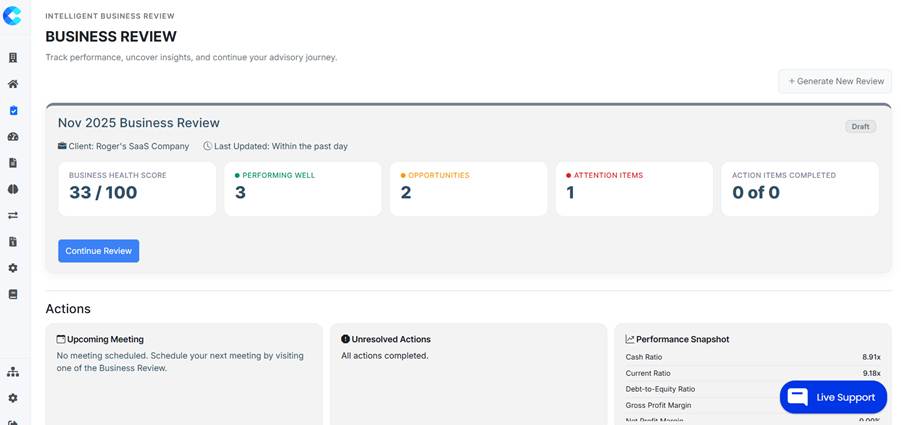
    Monthly business reviews become strategic sessions. Instead of spending 40 minutes walking clients through pre-built reports, you ask the platform to generate insights on key variances, then spend the entire hour discussing what to do about them. Planir’s AI-powered business review feature automatically identifies significant changes in financial performance such as revenue swings, margin compression, unusual expense patterns and generates natural language explanations for each variance. Accountants can review these AI-generated insights, add their professional context, and deliver a polished advisory narrative in a fraction of the traditional time.

    Ad-hoc questions get instant answers. When a client texts you mid-month asking about their cash runway, you don’t need to log into three systems and build a custom report. With Planir, you can ask “How many months of cash runway do we have based on current burn rate?” and receive an immediate calculation with supporting data. You query the AI, verify the output, and respond in minutes, not hours.

    Onboarding gets faster and more transparent. New clients often struggle to understand their own financials. Conversational interfaces let them explore their data naturally, asking beginner questions without feeling foolish. Planir can be configured to provide client portal access, allowing business owners to ask questions like “What’s my gross profit margin?” or “Which customers haven’t paid in over 60 days?” without waiting for their accountant all while you maintain oversight of all queries and responses. This builds financial literacy while reducing the “what does this number mean?” email backlog.

    Anomaly detection becomes proactive. Modern platforms don’t wait for you to ask. Planir’s smart alert system continuously monitors your clients’ financial data for patterns that matter like sudden drops in cash reserves, customers exceeding credit terms, expense categories trending above budget, or revenue concentration risks. When the AI detects something noteworthy, it sends contextualized alerts that explain not just what changed, but why it matters and what questions you should ask next. Smart alert systems monitor cash flow, margin compression, and unusual patterns and then notify you with context before small issues become client emergencies.

    Planir Business Review Functionality

    Now is the time to build advisory services and grow with AI

    Client advisory services are expanding across firms in 2026, with AI handling data preparation so accountants can focus on interpretation and strategic guidance that commands higher fees.

    The economics are compelling. Traditional advisory engagements require significant analyst time to prepare insights before the valuable conversation even begins. Conversational AI collapses that prep time from hours to minutes, letting you serve more clients at better margins without hiring additional staff. Early Planir adopters may reduce monthly close and analysis time significantly, reallocating those hours to higher-value advisory conversations that command premium fees.

    There’s also a competitive moat forming. Firms that embed conversational intelligence into their client experience are setting new service expectations. Once a business owner experiences getting answers in seconds instead of days, they won’t tolerate the old model. Your competitors who move first will make your dashboard-based service feel outdated fast.

    Advisory is becoming the strategic core of accounting firms, not the sidecar, as firms stop starting relationships with deliverables and instead lead with decisions, insight and direction.

    What to look for in an AI accounting platform: Key features for cloud accounting applications

    Not all conversational AI is created equal. When evaluating AI accounting software, consider these criteria:

    Data connectivity. Seamless integration with your clients’ existing tech stack such as QuickBooks, Xero, NetSuite, or whatever they’re running. If onboarding requires a data migration project, adoption will stall. Planir integrates directly with major accounting platforms through secure API connections, automatically syncing transaction data, chart of accounts, and customer/vendor records without manual exports or CSV uploads.

    Explanation transparency. The platform should show its work. When it calculates a metric or identifies a trend, you need to see the underlying logic and source transactions. Black-box answers erode trust. Every answer Planir provides includes a “Show Details” option that reveals the exact calculation logic, source transactions, and data lineage, giving you full audit trail visibility and the confidence to stake your professional reputation on AI-generated insights.

    Customization without coding. Your semantic layer should reflect how your clients actually talk about their business like custom KPIs, industry terminology, and all without requiring a data engineer. Planir allows you to define custom metrics, industry-specific KPIs, and client-specific business rules through a visual interface. A construction firm can track “job profitability by project phase” while a SaaS company monitors “monthly recurring revenue by customer cohort”—all without writing a single line of code.

    Audit trail and governance. Conversational doesn’t mean casual. Every query, answer, and drill-down should be logged for compliance and quality control. Planir maintains a complete audit log of all queries, AI-generated responses, and user interactions, meeting the documentation requirements accounting firms need for quality control and professional standards compliance.


    Planir’s conversational AI analytics: A closer look

    CapabilityTraditional DashboardsConversational AI (e.g., Planir)
    Answer “why” questionsManual investigation requiredInstant drill-down explanations
    Time to insightHoursSeconds to minutes
    Technical skill requiredSQL/Excel proficiencyPlain English questions
    Audit trailManual documentationAutomatic logging
    Proactive insightsNot availableFlag anomalies before you ask
    Advisory-ready outputRequires manual formattingNatural language explanations ready for client delivery

    The best platforms feel invisible. They integrate into your existing workflow, use terminology your clients already understand, and deliver insights that feel advisory-ready from the first interaction.

    Ready to transform how your firm delivers financial insights?

    Planir’s AI-powered platform turns your raw financial data into advisory-ready conversations, automates variance analysis, and helps you scale client advisory services without adding headcount. Whether you’re seeking the best accounting software for small business clients, small company accounting software with AI capabilities,or looking to enhance your firm’s AI for accounting capabilities, the technology exists — sign up for a free starter account today.

    This article is based on sources including Mordor Intelligence’s AI in Accounting Market Report, Accounting Today’s 2026 technology predictions and trends analysis, Google Cloud’s research on conversational analytics APIs, and Inside Public Accounting’s insights on the evolution of advisory services in accounting firms.

  • The Rise of Continuous Financial Forecasting: Why Static Budgets Are Obsolete in the Age of AI

    The Rise of Continuous Financial Forecasting: Why Static Budgets Are Obsolete in the Age of AI

    The budgeting model that was built for a different era

    For decades, annual budgeting was one of finance’s most reliable tools. It brought structure, discipline, and a shared financial language to leadership teams. In a world where markets evolved gradually and operational change was relatively predictable, locking plans once a year was both practical and efficient.

    That logic still shapes how many organizations operate today. Static budgets remain the foundation of financial planning in many firms, often supported by AI for accounting and modern reporting software. The tools have advanced. The planning model, in many cases, has not.

    The challenge is not that static budgets are inherently flawed. They were designed for a very different operating environment.

    Today’s business conditions move at a fundamentally different pace. Economic cycles turn faster. Customer demand shifts abruptly. External forces such as inflation, labor availability, and supply chain disruption can alter outcomes in weeks or months rather than years (Navarro, 2025).

    Finance teams now have access to richer data through cloud accounting automation applications yet many rely onj planning models designed for stability rather than change. As a result, the usefulness of a fixed annual plan often begins to erode almost as soon as it is finalized. Assumptions that were reasonable at the start of the year become outdated well before the year ends.

    What follows is familiar to most finance leaders. Teams spend increasing amounts of time reconciling actual performance against a plan that no longer reflects current conditions. The budget remains in place, but its role quietly shifts from guiding decisions to explaining variances.

    This growing disconnect between how organizations operate and how they plan has prompted a broader rethinking of forecasting itself. Rather than treating planning as a periodic event, finance leaders are beginning to see it as a continuous process. The rise of continuous forecasting reflects this shift. It is not driven by technology alone, but by the need for planning approaches that can adapt as uncertainty becomes persistent rather than exceptional.

    What static budgets were built to do and why they now fall short

    Static budgets emerged as fixed planning instruments anchored to predefined assumptions (Controllers Council, 2025). For many years, this approach worked. Leadership teams aligned around a single plan, performance was measured against agreed targets, and deviations were investigated through variance analysis.

    As conditions change more frequently, however, those fixed assumptions become increasingly difficult to defend over the course of a year.

    Rigidity creates friction inside finance teams. Instead of updating plans to reflect new information, teams are required to explain why reality no longer aligns with assumptions made months earlier. Planning discussions become backward-looking by design.

    Finance leaders are acutely aware of this limitation. McKinsey’s research shows a clear shift away from short-term, fixed planning cycles toward longer-term, strategic priorities (Agrawal & Grube, 2024). Rather than anchoring finance around static targets, leaders are increasingly focused on strategic planning and long-term resource allocation (Agrawal & Grube, 2024).

    This shift exposes the core weakness of static budgets. They are structurally ill-suited to environments where assumptions must change continuously rather than annually.

    The rise of continuous forecasting as an operating response

    As finance leaders confront the limitations of fixed annual plans, continuous forecasting has emerged as a practical response rather than a theoretical upgrade. It reframes planning from a periodic exercise into an ongoing process that evolves with the business (Navarro, 2025).

    Instead of locking assumptions once a year, continuous forecasting allows finance teams to update projections as new information becomes available (Navarro, 2025). Planning horizons extend beyond a single fiscal year, while remaining responsive to near-term change.

    Crucially, continuous forecasting is not about predicting the future with perfect accuracy. Its value lies in relevance (Navarro, 2025). By keeping forecasts current, finance teams provide leadership with a planning framework that reflects how the business is operating, not how it was expected to operate months earlier.

    What finance teams must unlearn and the CFO’s planning mandate

    Moving to continuous forecasting requires more than new processes. It requires a shift in mindset. Many finance teams have been trained to equate control with fixed targets. Continuous forecasting reframes control around assumptions rather than numbers. This change can be uncomfortable, particularly in organizations accustomed to rigid performance benchmarks.

    Rather than attempting to eliminate uncertainty, finance teams must learn to adapt to it more quickly.This shift mirrors broader changes in the CFO role. CFOs increasingly describe their priorities in terms of strategic planning rather than short-term performance tracking. In this context, the CFO becomes less a guardian of static budgets and more a steward of assumptions and scenarios.

    Continuous forecasting supports this mandate by providing a planning framework that evolves alongside strategy rather than constraining it.

    Continuous forecasting as the foundation of modern advisory finance

    As forecasting becomes continuous, the nature of finance’s contribution changes. Insights become timelier. Analysis becomes more decision relevant. Finance moves from explaining performance to shaping outcomes.

    This enables finance teams to operate in a genuinely advisory capacity rather than a purely reporting one. Technology such as AI accounting software plays an enabling role, but it is not the driver of this shift. Without changes to planning models, automation risks reinforcing outdated processes rather than transforming decision-making.

    Why static budgets no longer lead

    Static budgets still serve a purpose. They provide baseline structure, alignment, and governance though they are no longer sufficient as the primary mechanism for navigating a constantly changing business environment. Continuous forecasting now leads, with static budgets playing a supporting role rather than dictating decisions.

    The question facing finance leaders is no longer whether planning should adapt, but whether their organizations can afford to rely on models designed for a different era. In an environment defined by speed and uncertainty, the ability to continuously reassess assumptions has become a strategic advantage, not an operational nice-to-have.

    Where Planir fits in this shift

    As continuous forecasting becomes the dominant planning model, the constraint for finance teams is no longer access to data, but the ability to interpret it consistently and at speed. Forecasts are only as useful as the clarity they provide, and clarity depends on how well financial signals are translated into actionable insight.

    This is the gap platforms like Planir are designed to address. Rather than replacing professional judgment, Planir acts as an intelligence layer that connects financial data, forecasts, and assumptions into coherent, decision-ready narratives. In an environment where planning is continuous, not episodic, that connective tissue becomes essential.

    The future of finance will not be defined by who automates the most tasks, but by who enables better decisions at a faster rate. Continuous forecasting sets the direction. Tools that turn forecasts into understanding will determine who leads.

    References

    Agrawal, A., & Grube, C. (2024, July 18). Toward the long term: CFO perspectives on the future of finance. McKinsey & Company. https://www.mckinsey.com/capabilities/strategy-and-corporate-finance/our-insights/toward-the-long-term-cfo-perspectives-on-the-future-of-finance#/

    Council, C. (2025, August 19). From Static to Rolling Forecasts: Designing a Continuous Planning Cycle – Controllers Council. Controllers Council. https://controllerscouncil.org/from-static-to-rolling-forecasts-designing-a-continuous-planning-cycle/

    How a Continuous Planning System Can Help You Prepare for the Unexpected – SPONSOR CONTENT FROM WORKDAY AND ACCENTURE. (2023, August 16). Harvard Business Review. https://hbr.org/sponsored/2023/08/how-a-continuous-planning-system-can-help-you-prepare-for-the-unexpected

    ‌Navarro, B. J. (2025, April). Continuous Planning in Finance: The Complete Guide. Workday Blog; Workday,Inc. https://blog.workday.com/en-us/continuous-planning-in-finance-the-complete-guide.html