Lead: Conversational AI is transforming how accountants and CFOs analyze financial data. Instead of clicking through dashboards and manually tracing transactions, you can ask questions in plain English like “Why did margins drop?” and get instant, drill-down answers. This article explores how AI accounting software is enabling this shift, what to look for in a platform, and how Planir helps firms scale advisory services without adding headcount.
Picture this: A client asks you a simple question during your quarterly review. “Why did our gross margin drop three points last month?”
You could spend the next hour clicking through dashboard tabs, cross-referencing reports, and manually tracing transactions. Or you could get the answer, complete with drill-down context, in seconds.
That’s not science fiction. It’s AI for accounting in action, a market expected to reach USD 69.75 billion by 2031, and conversational AI is leading the charge. The question isn’t whether your firm will adopt this technology. It’s whether you’ll be early enough to turn it into a competitive edge.
The dashboard dilemma
Traditional financial dashboards excel at one thing: showing you what happened. Revenue grew 12%. Cash flow dipped. Customer acquisition costs spiked in Q3.
What they don’t do well is answer the question every business owner asks: Why?
Most BI tools force finance teams into a frustrating loop. You spot an anomaly on a dashboard, open a report, export to Excel, pivot the data, then manually investigate transaction details. By the time you’ve traced the root cause, you’ve burned two hours and your client’s patience.
AI is putting client advisory services on every accountant’s menu in 2026, as AI becomes the super assistant that gives accountants capacity to deliver advisory work clients always hoped for. The firms capitalizing on this shift aren’t just automating data entry; they’re reimagining how clients interact with their numbers entirely. Platforms like Planir are at the forefront of this transformation, turning raw financial data into advisory-ready insights through conversational AI that understands accounting context, not just keywords.
Enter conversational intelligence: How AI accounting software is changing the game
Conversational AI flips the script. Instead of navigating menus and filtering reports, you ask questions in plain English. “Show me which product lines drove the margin decline” or “What’s causing our days sales outstanding to climb?”
The technology combines natural language processing with what’s called a semantic layer,a business logic engine that understands your chart of accounts, KPI definitions, and dimensional relationships. Natural language query engines, such as available via Google Cloud’s Conversational Analytics, translate user questions into semantically equivalent queries, allowing users to ask questions like “What is the average sales value per order item?” without writing any SQL.
Here’s what makes it powerful: conversational AI doesn’t just surface top-line metrics. It enables intelligent drill-down. Ask about revenue performance, and it shows you revenue by region. Ask which region underperformed, and it shows you revenue by customer within that region. Ask about a specific customer, and it surfaces the actual invoices. In each conversation, an answer leads naturally to the next question, the same way an actual business conversation unfolds.
How advisory firms are using AI accounting software right now
The practical applications of modern accounting software go far beyond client meetings. Here’s how forward-thinking practices are deploying conversational financial analysis:
Monthly business reviews become strategic sessions. Instead of spending 40 minutes walking clients through pre-built reports, you ask the platform to generate insights on key variances, then spend the entire hour discussing what to do about them. Planir’s AI-powered business review feature automatically identifies significant changes in financial performance such as revenue swings, margin compression, unusual expense patterns and generates natural language explanations for each variance. Accountants can review these AI-generated insights, add their professional context, and deliver a polished advisory narrative in a fraction of the traditional time.
Ad-hoc questions get instant answers. When a client texts you mid-month asking about their cash runway, you don’t need to log into three systems and build a custom report. With Planir, you can ask “How many months of cash runway do we have based on current burn rate?” and receive an immediate calculation with supporting data. You query the AI, verify the output, and respond in minutes, not hours.
Onboarding gets faster and more transparent. New clients often struggle to understand their own financials. Conversational interfaces let them explore their data naturally, asking beginner questions without feeling foolish. Planir can be configured to provide client portal access, allowing business owners to ask questions like “What’s my gross profit margin?” or “Which customers haven’t paid in over 60 days?” without waiting for their accountant all while you maintain oversight of all queries and responses. This builds financial literacy while reducing the “what does this number mean?” email backlog.
Anomaly detection becomes proactive. Modern platforms don’t wait for you to ask. Planir’s smart alert system continuously monitors your clients’ financial data for patterns that matter like sudden drops in cash reserves, customers exceeding credit terms, expense categories trending above budget, or revenue concentration risks. When the AI detects something noteworthy, it sends contextualized alerts that explain not just what changed, but why it matters and what questions you should ask next. Smart alert systems monitor cash flow, margin compression, and unusual patterns and then notify you with context before small issues become client emergencies.
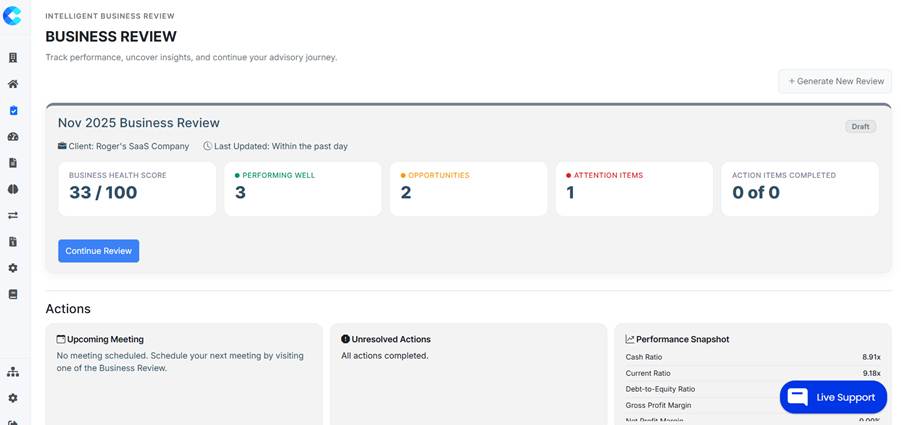
Planir Business Review Functionality
Now is the time to build advisory services and grow with AI
Client advisory services are expanding across firms in 2026, with AI handling data preparation so accountants can focus on interpretation and strategic guidance that commands higher fees.
The economics are compelling. Traditional advisory engagements require significant analyst time to prepare insights before the valuable conversation even begins. Conversational AI collapses that prep time from hours to minutes, letting you serve more clients at better margins without hiring additional staff. Early Planir adopters may reduce monthly close and analysis time significantly, reallocating those hours to higher-value advisory conversations that command premium fees.
There’s also a competitive moat forming. Firms that embed conversational intelligence into their client experience are setting new service expectations. Once a business owner experiences getting answers in seconds instead of days, they won’t tolerate the old model. Your competitors who move first will make your dashboard-based service feel outdated fast.
Advisory is becoming the strategic core of accounting firms, not the sidecar, as firms stop starting relationships with deliverables and instead lead with decisions, insight and direction.
What to look for in an AI accounting platform: Key features for cloud accounting applications
Not all conversational AI is created equal. When evaluating AI accounting software, consider these criteria:
Data connectivity. Seamless integration with your clients’ existing tech stack such as QuickBooks, Xero, NetSuite, or whatever they’re running. If onboarding requires a data migration project, adoption will stall. Planir integrates directly with major accounting platforms through secure API connections, automatically syncing transaction data, chart of accounts, and customer/vendor records without manual exports or CSV uploads.
Explanation transparency. The platform should show its work. When it calculates a metric or identifies a trend, you need to see the underlying logic and source transactions. Black-box answers erode trust. Every answer Planir provides includes a “Show Details” option that reveals the exact calculation logic, source transactions, and data lineage, giving you full audit trail visibility and the confidence to stake your professional reputation on AI-generated insights.
Customization without coding. Your semantic layer should reflect how your clients actually talk about their business like custom KPIs, industry terminology, and all without requiring a data engineer. Planir allows you to define custom metrics, industry-specific KPIs, and client-specific business rules through a visual interface. A construction firm can track “job profitability by project phase” while a SaaS company monitors “monthly recurring revenue by customer cohort”—all without writing a single line of code.
Audit trail and governance. Conversational doesn’t mean casual. Every query, answer, and drill-down should be logged for compliance and quality control. Planir maintains a complete audit log of all queries, AI-generated responses, and user interactions, meeting the documentation requirements accounting firms need for quality control and professional standards compliance.
Planir’s conversational AI analytics: A closer look
| Capability | Traditional Dashboards | Conversational AI (e.g., Planir) |
| Answer “why” questions | Manual investigation required | Instant drill-down explanations |
| Time to insight | Hours | Seconds to minutes |
| Technical skill required | SQL/Excel proficiency | Plain English questions |
| Audit trail | Manual documentation | Automatic logging |
| Proactive insights | Not available | Flag anomalies before you ask |
| Advisory-ready output | Requires manual formatting | Natural language explanations ready for client delivery |
The best platforms feel invisible. They integrate into your existing workflow, use terminology your clients already understand, and deliver insights that feel advisory-ready from the first interaction.
Ready to transform how your firm delivers financial insights?
Planir’s AI-powered platform turns your raw financial data into advisory-ready conversations, automates variance analysis, and helps you scale client advisory services without adding headcount. Whether you’re seeking the best accounting software for small business clients, small company accounting software with AI capabilities,or looking to enhance your firm’s AI for accounting capabilities, the technology exists — sign up for a free starter account today.
This article is based on sources including Mordor Intelligence’s AI in Accounting Market Report, Accounting Today’s 2026 technology predictions and trends analysis, Google Cloud’s research on conversational analytics APIs, and Inside Public Accounting’s insights on the evolution of advisory services in accounting firms.