AI accounting software has become increasingly common as firms face rising client expectations, tighter timelines, and more complex financial environments. Yet despite rapid adoption, many accounting teams still struggle to translate AI-driven automation into meaningful insight or advisory value.
Recent industry research shows that 56% of accountants spend a significant portion of their time on repetitive manual tasks, while only 26–50% of accounting activities are currently automated (Pardo, 2023). These figures highlight a paradox. AI accounting software is widely available, yet much of the profession remains constrained by operational work that limits interpretation, analysis, and decision-making.
The issue is not the availability of AI accounting software. It is where its capabilities stop.
How AI Accounting Software Is Commonly Understood (and Why That Definition Falls Short)
The term AI accounting software is often used as a catch-all. In practice, it describes tools that solve very different jobs within accounting workflows.
Most platforms focus on:
- Capturing data faster
- Processing transactions more efficiently
- Producing reports with less effort
These improvements matter, but they do not automatically produce insight or advisory clarity.
To understand why Planir represents a structural shift, it helps to look at the three layers where AI is typically applied in accounting and where the real limitation emerges.
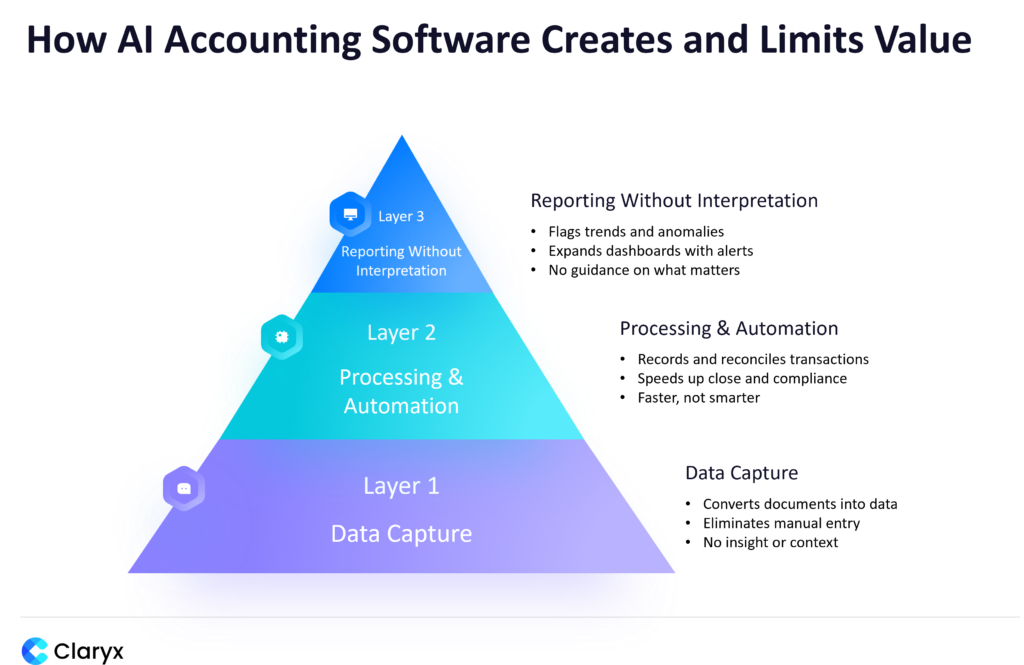
Layer 1 of AI Accounting Software: Data Capture
Data capture tools convert invoices, receipts, and bank statements into structured data. They address one of the biggest pain points in accounting: manual entry.
This layer plays an important role in reducing workload and error, particularly given the high proportion of time still spent on repetitive tasks (Pardo, 2023). However, data capture only answers one question: what information do we have?
It does not explain:
- Why numbers changed
- What patterns matter
- What action should follow
Data capture is foundational, but it is not where accounting value is created.
Layer 2 of AI Accounting Software: Processing and Automation
Processing tools take structured data and turn it into journals, ledgers, and reconciled accounts. This is where most cloud accounting systems operate today.
Adoption here is accelerating. 43% of accountants have begun automating transaction processes, primarily to reduce repetitive work and improve efficiency (Brown, 2025). Platforms such as Xero, QuickBooks, and Zoho Books excel at this layer.
But even at full automation, processing systems still focus on:
- Recording what happened
- Ensuring compliance
- Closing the books faster
They do not help accountants decide what the results mean. At best, they make firms faster not insightful.
Layer 3 of AI Accounting Software: Reporting Without Interpretation
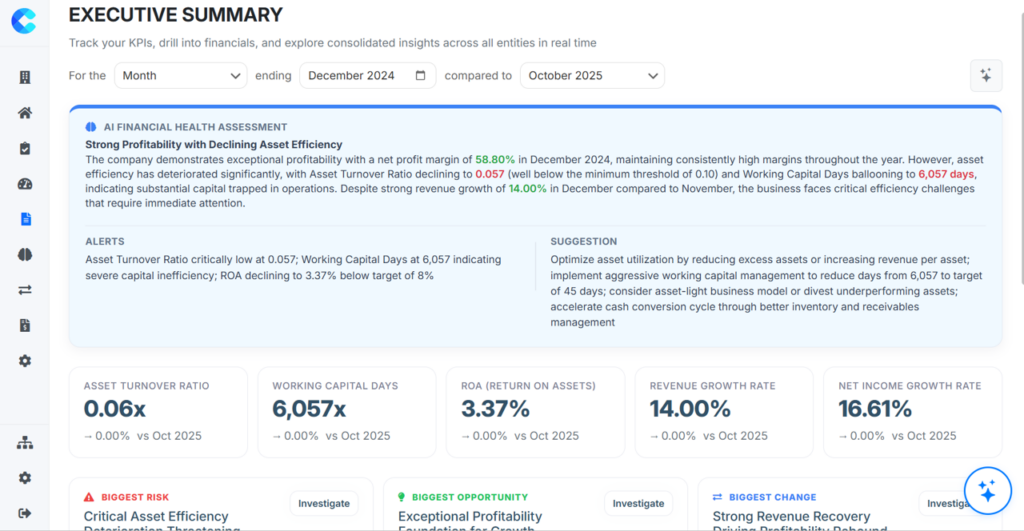
Reporting tools were originally designed to visualise financial performance through dashboards and statements. More recently, many have added AI features to surface trends, flag anomalies, or generate basic narratives.
This evolution reflects a broader shift. As automation reduces compliance effort, 95% of firms report having more capacity to redirect time toward client-facing and advisory work (Brown, 2025).
Yet this is where most AI accounting software still falls short. Many platforms can show what changed, few can help accountants explain why it matters or what to do next.
This gap between information and interpretation is where Planir changes the landscape.
The Missing Advisory Layer in AI Accounting Software
Planir is not designed to replace data capture, processing, or reporting tools. It is designed to sit on top of them.
Where most AI accounting software stops at visualisation or detection, Planir focuses on structuring interpretation.
Specifically, Planir helps accountants:
- Prioritise which signals matter
- Apply business context to AI-identified patterns
- Translate financial movements into decision-ready insights
- Prepare clearer, more focused advisory discussions
Rather than treating insight as something accountants must manually assemble after reports are produced, Planir treats interpretation as a first-class layer in the workflow.
This is why Planir is not just another reporting tool it represents a shift in how AI supports accounting work.
From AI Accounting Automation to Advisory Enablement
Many firms adopt AI accounting software to gain speed. The most competitive firms adopt it to gain clarity.
Research consistently shows that accountants who treat AI as a collaborator remain actively involved in questioning outputs, applying context, and deciding how insights inform action extract more value than those who treat it as a replacement (Murray, 2025).
Planir is built around this reality. It does not automate judgment, it supports it. By reducing the effort required to move from data to interpretation, Planir helps firms use AI not just to work faster,but to work at a higher level.
If you want to test what happens when AI accounting automation is paired with structured interpretation, start a Planir trial.
See how faster reporting becomes clearer advisory conversations without replacing professional judgment.
Source
Murray, S. (2025, June 26). AI Is Reshaping Accounting Jobs by Doing the “Boring” Stuff. Stanford Graduate School of Business; Stanford University. https://www.gsb.stanford.edu/insights/ai-reshaping-accounting-jobs-doing-boring-stuff
Pardo, S. B. (2023, May 12). Dext: 60% of accountants spend too much time on manual tasks. The Accountant. https://www.theaccountant-online.com/news/dext-60-of-accountants-spend-too-much-time-on-manual-tasks/
QuickBooks. (2025, July 30). 2025 Intuit QuickBooks Accountant Technology Report | Intuit QuickBooks. Firmofthefuture.com. https://www.firmofthefuture.com/news/accountant-tech-survey-2025/